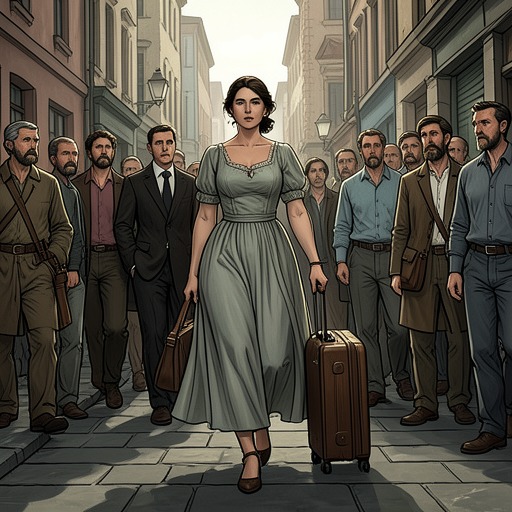
Sexy Separates by Trixie Fashion Show and Brand Launch Event
It Must Be Love: A Mustang Prairie RomanceSexy Separates by Trixie is the decisive public launch of Trixie Beaumont’s lingerie venture, transforming months of private planning and uncertain labor into a visible professional success. The event matters not only because the collection reaches an audience, but because Trixie must stand behind the work as its designer, organizer, and owner. The runway gives material form to a dream that had previously existed in sketches, business plans, folded garments, and anxious calculations, while the applause offers public confirmation that her independent creative and commercial identity has taken hold.
From Delayed Dream to Defined Collection
Trixie had spent several months seriously considering the creation of a clothing line. She experimented with names, sketched logo ideas, and even worked with a graphic designer to make those ideas tangible. Instead of encouraging her, the finished logos began to taunt her because she still had not acted. The launch therefore begins long before the runway: it is the consequence of converting hesitation into a concrete business decision.
The collection’s first clear identity emerged during a long weekend at Trixie’s rental house, while she folded panties for a new display table. She settled on the name Sexy Separates by Trixie and imagined six to ten panty styles, ranging from g-strings and bikinis to French cuts in silk, lace, and cotton, with a possible boy-cut option. A rainbow theme would accommodate vibrant colors, while four bra styles, including a convertible bra, would allow customers to mix and match. Her preference for coordinated sets did not dictate the whole line; Sadie’s habit of combining mismatched colors helped Trixie recognize that customers could want variety and personal choice instead.
This design philosophy was tied to a practical expansion of Trixie’s existing business. Under the Skirt Online had officially opened after several consecutive profitable months, and Trixie considered renting the neighboring space as both a warehouse and a possible workroom. She also imagined hiring a part-time employee earlier than projected. Yet she treated the line as her livelihood and source of stability, not as a carefree experiment. Her parents had provided affection and material support but had moved from hobby to hobby, interest to interest, religion to religion, and place to place; Trixie’s determination to proceed safely reflects her wish to build the dependable foundation they had never modeled for her.
Preparation, Control, and Labor
The launch depends on a chain of work that extends beyond designing garments. Before the show, Trixie’s shop already required sales, stock management, steaming, folding, customer service, and financial administration. When an injury left her exhausted and in pain, she could no longer re-fold or steam the merchandise and had to limit herself to shouting instructions and operating the digital register. During the quiet part of that day, however, she kept working on the line in her sketchpad. Even physical incapacity did not end the project; it redirected her labor from shop-floor maintenance toward design.
Trixie also began creating a separate workspace. She had opened a hole into the neighboring area, concealed it temporarily with a curtain, and planned to have Derek Hayes begin the construction on Black Friday. The improvised opening signals both ambition and risk: the business was expanding before its infrastructure was finished. Her commitment to control remained equally strong when Jonquil Spring helped rank prospective seamstresses. Although Jonquil suggested reconsidering a manufacturer because some candidates were unsuitable, Trixie refused to surrender quality control while the line was new. She would consider manufacturing only after the brand became solid, preserving direct oversight of the product during its most vulnerable stage.
By the time the show approached, Trixie had three seamstresses and was receiving orders at a rate above her expectations, although not yet at a level she considered impressive. This combination of growth and uncertainty defines the event’s stakes. The show is not a decorative interlude detached from commerce; it is a market test, a promotional campaign, and a public declaration that the line deserves to exist. The later presence of orders through the following week shows that the launch feeds directly into ongoing production and fulfillment rather than ending with the final walk.
The Runway at Dylan’s Bar
The fashion show takes place in Dylan’s bar, where a makeshift runway divides the room in half. Trixie watches from behind the staging area as Sadie and the other models present the collection. Several of Sadie’s and Kiki Ramirez’s songs provide the soundtrack, while lighting and gauzy fabric hung from the ceiling transform the bar into something resembling one enormous bedroom. The setting combines a local community space with the visual language of lingerie advertising, making the launch both intimate and public: a small-town venue is temporarily converted into a professional-looking performance environment.
Sadie opens the show in lacy teal boy shorts with a matching Basque and a fiercely seductive smile. Later she returns in a white cheeky brief and matching bra beneath a silky duster with matted silver buttons, completed by cherry-red stilettos. Trixie identifies this second appearance as the image that could launch the line. The design is not presented as a static object; it is activated through movement, posture, music, lighting, and the model’s ability to flirt with the entire room. The garments become a visual vocabulary through which the line communicates its chosen combination of sexiness and playfulness, summarized by the new tagline, “Sexy and fun.”
The event also draws on the social world surrounding Trixie. Sadie’s participation lends the collection a recognizable body and performer, while Kiki’s music helps make the show feel like a shared production rather than a solitary commercial venture. The support is practical and emotional at once. Trixie has designed the clothing, but the launch depends on seamstresses, models, musicians, photographers, venue workers, and friends who help turn her work into an experience that others can see and remember.
Public Success and Private Absence
Trixie’s emotional response rises with the music. Her heart beats nearly as loudly as the soundtrack, and she wants to preserve the feeling of completion. As the models finish, she races behind the staging area and threads her fingers through Sadie’s. The models line up behind her, brushing her hands in congratulations, and she walks toward the runway amid flashing lights, smiling faces, and wolf whistles that she suspects came from Ty Scanlon and Dylan. The movement from backstage to the runway is therefore a ceremonial passage: she leaves the hidden labor of preparation and enters the public space as the person responsible for the finished line.
Sadie tells her to smile because it is her night and squeezes her hand until she does. Trixie answers the encouragement with the realization that she has done it. The show is officially launched, and she considers it a success. Interviews, sound bites, and photographs follow during the roughly ninety-minute interval before the after-party, bringing attention from fashion publishers and bloggers. The exhausting circuit of publicity resembles a workout: demanding, physical, and satisfying because it proves that the work has moved beyond the shop and into a wider professional conversation.
The triumph contains a sharp emotional absence. Trixie feels satisfied, but she also recognizes that she has no one to share the achievement with in the fullest sense. Jack Thorpe is present at the front of the bar, leaning against it with his legs crossed and smiling at her as though she matters to him. His presence gives the moment an intimate charge, even as Trixie tries to keep the night hers. She refuses to let thoughts of their sexual relationship overtake the occasion, insisting internally that the evening belongs to her achievement rather than to Jack. The launch thus produces two simultaneous victories: professional recognition and a clearer, if painful, awareness of the emotional companionship she still lacks.
Significance in Trixie’s Development
The show marks the point at which Trixie’s entrepreneurial project becomes legible to other people. Earlier, the line lived in logos that mocked her inaction, sketches made during quiet shop hours, a concealed passage into an unfinished neighboring space, and plans for future staff or manufacturing. At Dylan’s bar, those fragments become a coordinated public identity: a name, a range of products, a visual theme, a tagline, models, music, photography, and an audience.
Its success also demonstrates that Trixie’s independence is built through organization rather than fantasy alone. She designs for different preferences, protects quality by retaining control over early production, uses existing business profits to support expansion, and treats publicity as part of the work. Her clothing is sensual, but her achievement is not reducible to the erotic display onstage. The garments represent choices about accessibility, combination, color, labor, branding, and commercial scale, allowing women to construct their own sets instead of obeying a single ideal of matching femininity.
As a transition in the broader story, Sexy Separates by Trixie carries Trixie from private aspiration into public authorship. Sadie’s congratulatory handclasp, the models’ embrace, the applause, and Jack Thorpe’s attentive smile all confirm different forms of recognition, but none cancels the fact that Trixie created the line and made the launch happen. The event’s deepest achievement is therefore not simply that the show succeeds. It is that Trixie can finally stand inside the success and name it as hers.